Research projects
Eutrophication of the Baltic Sea – consequences for stickleback populations
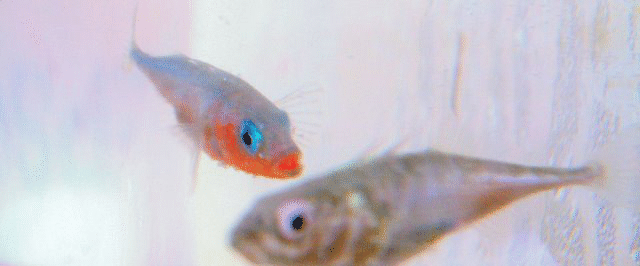
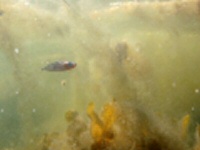 The environment of the Baltic Sea is currently changing due to eutrophication. Increased input of nutrients is enhancing the growth of filamentous algae and phytoplankton, which changes the structure of the habitats and reduces visibility. The short-term effects of eutrophication are well-known, but the longer term consequences, for ecological and evolutionary processes, are largely unknown. We investigate the impact of rapid environmental changes on reproductive behaviour and the strength of sexual selection, and how this in turn influences the viability of populations. Our main model organism is the threespine stickleback.
Anthropogenic disturbances - influence on trophic cascades
Humans are altering aquatic ecosystems though both eutrophication and overfishing. We investigate the influence of changes in population dynamics of the threespine stickleback on the growht of filamentous algae. Population dynamics of the threespine stickleback are expected to change becuase of the removal of top-predators. This could in turn induce trophic cascades that influence the amount of filamentous algae that is not transferred to higher trophic levels but to decomposers, which in turn could influence the accumulation of mats of decaying algae.
A powerful way to reconstruct past responses of populations to human-induced environmental change is to use the information hidden in the sediment in the form of dormant eggs and subfossils. We investigate how and why the cladoceran community has changed in response to human-induced environmental change during the last century, using resurrection ecology, paleogenomics and paleolimnology.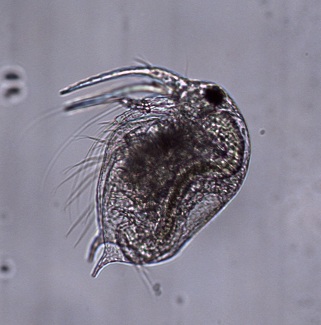
Monitoring of threespine stickleback populations (Gasterosteus aculeatus) in the archipelago of Southern Finland has revealed that sticklebacks breeding in eutrophied coastal waters are less parasitized than sticklebacks breeding in clean waters, particularly when it comes to the dominating parasite Schistocephalus solidus. There are two non-mutual explanations for the observed correlation between health and environmental conditions: a) differences in exposure to pathogens, b) differences in resistance to pathogens, which can have both a genetic and an environmental component. The first scenario could arise if the host has adjusted better than the pathogens to eutrophied conditions, resulting in a relatively pathogen free environment, while the second scenario could arise if the pathogens are less virulent (or hosts more resistant) in eutrophied areas, due to hosts leading the host-pathogen co-evolution.
 In the current project, we are monitoring Baltic Sea stickleback populations to increase our knowledge on the dependence of host-pathogen interactions on the degree of human induced eutrophication. We relate the findings to the abundance, life-history and environmental requirements of the pathogen species to evaluate the possible causes of the pattern. To reveal the causes, experimental work is performed.
Objectives:
- Determine the correlations between eutrophication and pathogenic infections in threespine stickleback populations in the Baltic Sea.
- Experimentally investigate the causes of the correlations for different pathogens