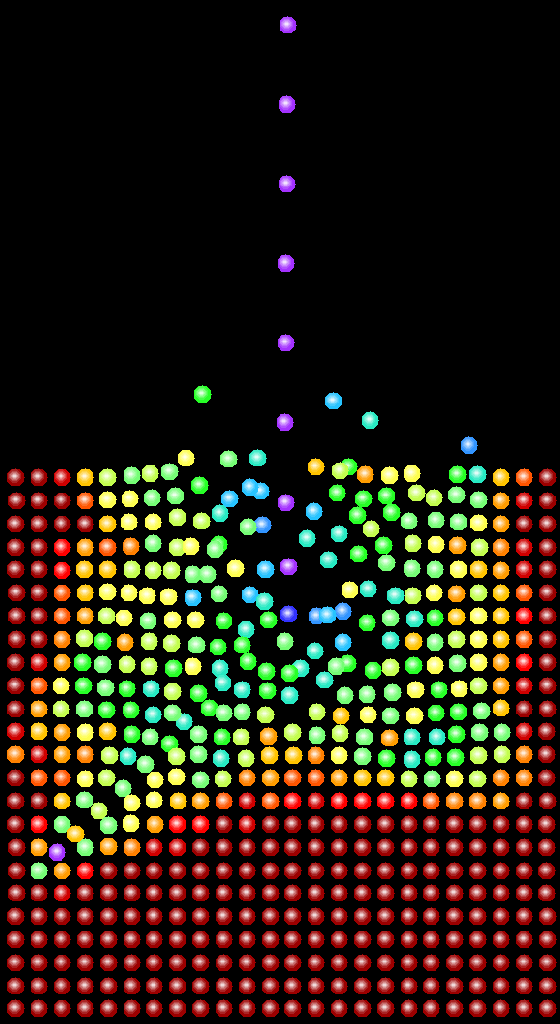
Summary in EnglishPrerequisites: Knowledge of the basics of programming and the Unix environment, the structure of matter and thermodynamics. The course is also suited to chemists.Contents: Visualization and animation of atomic data. Molecular dynamics simulations, which enable following the motion of a set of pointlike objects (typically but not necessarily atoms). During the course, the students get to write in a supervised manner their own molecular dynamics code, capable of simulating atom motion in simple metals. Genetic algorithm and conjugate gradient energy minimization of atomic systems. Overview of quantum mechanical and classical models of atomic interaction, and a detailed description of modern classical force models for metals, semiconductors, ionic and organic materials. Literature: Lecture notes. Yhteenveto suomeksiKurssin tarkoituksena on johdattaa opiskelija atomitasolla toimiviin fysikaalisiin simulointimenetelmiin ja antaa valmiudet kirjoittaa simulointikoodeja käytännössä. Kurssin aikana osallistujat kirjoittavat ohjatusti yksinkertaisen simulointikoodin. Opittuja koodausmenetelmiä voi käyttää hyväksi useissa muissakin yleisissä fysiikalisissa simuloinneissa. Lisäksi kurssilla esitellään viimeaikaista kehitystä simulointimenetelmissä ja atomistisissa vuorovaikutusmalleissa tarkoituksena antaa yleiskuva siitä millaista mallia kannattaa soveltaa mihinkin ongelmaan.Kurssin sisältö: Tietokonesimuloinnit fysiikassa, atomidatan visualisointi ja animointi, molekyylidynaamiset simulointimenetelmät, atomistisistä vuorovaikutusmalleista: kvanttimekaanisten, tight-binding- ja semiempiiristen mallien käyttöalueet, "breathing sphere"- polymeerimalli, geneettiset algoritmit rakenne-optimoinnissa sekä atomistisen simulointidatan vertaaminen kokeisiin. Lecturer 2003: Prof. Kai Nordlund Lectures Tue 12-14 room D114 Exercises Thus 12-14 Accelerator laboratory seminar room! (note change) First lecture Tue 14.1 at 12.15
The course is given in English in anyone who does not know Finnish turns up. Literature: lecture notes. As background material e.g. the books
may be used. Requisite background information: The basics of programming and the Unix environment. Basic knowledge of the structure of matter and thermodynamics.
|  |