|
"Impact of Ranomafana National Park on Living Conditions of Local People in Madagascar – A Life Security Perspective "
RESEARCH PROPOSAL
Contents
Kaisa Korhonen Department of Social Policy/
University of Helsinki, Finland
National parks are established primarily to conserve nature beyond the human needs. They also have a strong recreation function; as the name expresses: they are to conserve the national natural heritage for the people. The number of national parks has increased world wide in recent years (West 1991). The whole national park model originates from Northern America in 19 th century but it is the one of the most applied model of nature protection in the developing world. The national parks in the developing world are mostly introduced by foreign conservation organisations. In many cases the local context has been overviewed and number of conservation projects have suffered the lack of local support and understanding (Hough 1988). Local people have felt that conservation done by the government or the foreign institutions had not benefited them, on the contrary they have had to confront new restrictions (Brechin et al. 1991). This is the question in all nature conservation which has to face the problem between human and "nature's" interests (Wilhusen et al. 2002).Community- based or other people-oriented natural resources management programs such as integrated conservation and development projects (ICDPs), were designed to solve this problem. The first aim was to compensate the lost right to use resources for the local people (Brandon and Wells 1992). Around the conserved area is left a buffer zone where development activities will direct the people to change their nature-destructive farming practices into new techniques. As well new job opportunities such as being a guide, making handicrafts for tourists etc. are introduced. The emphasis in development themes varies between the projects nevertheless it has been crucial that development activities also have benefits for conservation. Without the linkages their connection with conservation could be very vague (Brandon 1998). However, also ICDPs and other participatory methods have confronted many problems. The idea of compensation or offering economic alternatives do not lead automatically nature conservation. This suggestion that poverty alleviation will enhance conservation "relies on number of tenuous assumptions about human behaviour" (Wilhusen et al. 2002). Many ICDPs have had to face the problem that development activities have not removed the pressure on the natural resources but on the contrary accelerated the destructive activities due the development which attracts e.g. immigration into area (Langholz 1999). For example, Ferraro and Kramer (1995, ref. Langholz 1999) reported the increase of living standards in the village of Ambatolahy in Ranomafana in the same time with accelerated deforestation rates around the village. This leads to the question what is considered the most important in the first place: the nature, the people or (if possible) the both? The debate between "pro people" and "pro nature"- approaches has continued in conservation literature for decades rooting from the western idea of separation of nature and man, which could be a strange idea for various other cultures. However, emphasising the indigenous and traditional ways of managing the natural resources and believing that in all cases "local people" have lived in harmonious equilibrium with the nature is not true at all either. An alternative view on conservation has be presented e.g. by some anthropologists who view international conservation movements similar to neo-imperialism (Grove 1995) and point out the equal importance of conservation of minor human cultures and languages. I believe that nature conservation should strongly take into account the human aspect. E.g. Brechin at al . (2002) have pointed out that the conservation is primarily a social process and should always be based on social justice. In this study, I try to explore the situation in one ICDP having my focus on people still not forgetting about the goals of conservation. 1.2 Ranomafana National Park Ranomafana National Park (RNP) is situated in south- eastern part of Madagascar belonging to Fianarantsoa province. The park was established in 1991 to conserve the biodiversity as a new lemur species was identified in the area in 1986 and after the recent investigations, it was realised that Ranomafana is one of the most important sites of primate diversity in the world (Wright 1997). The Ranomafana National Park Project (RNPP) was established as an ICDP and founded by USAID and organised by two U.S universities (Kightlinger et al. 1990). RNPP included six integrated components: health, conservation education, economic development, park management, ecoturism and biodiversity research (Wright 1997). The funding from USAID ended in 1997 when the management of the park was transferred to national half- governmental organisation (ANGAP) which duty is to manage national parks in the country and the developing activities (health and conservation education) were continued by MICET (the local environmental NGO). The human population surrounding the RNP live approximately 93 small communities, ranging in population from 10-600 people, with a total population of about 25 000 (in 1995) (Grenfell 1995). The Ranomafana National Park area consist of 43 500 ha heavily forested uninhabited land altitudinal gradient varying from 1374 m to 400 m above sea level (Wright 1997). The ecological circumstances differ in the park area from mild climate "lowlands" with steep slopes to more flat and cold highlands. People in lowlands have adapted the farming technique (shifting cultivation) suitable for local ecological conditions but they practise as well paddy rice and cash crop cultivation such as coffee and banana. People living in western and more high altitude parts cultivate mainly paddy rice in terraces. People in the park area have been classified to two ethnic groups: Tanala and Betsileo. However, the ethnicity cannot be considered as a fixed characteristic, especially in Madagascar the division to certain "ethnic" groups has been a result of economic activities the people practise rather than "ethnic characteristics" (Kottak 1971). These groups of people should be considered as culturally and economically adapted groups rather than ethnic tribes (Harper 1999). The shifting cultivation (tavy) practised mainly in lowlands of the park is seen as the biggest threat for primary forests and the park (ANGAP 1998, Oxby 1985). However, also the other factors have contributed the forest destruction, the exploitation of hard wood and cash crop cultivation (mainly coffee) introduced by the French in the beginning of the last century convert the forestland for other land use purposes and affected as well the substitute agriculture (Hanson 1996). The people have moved to Ranomafana area just over 200 years ago from central plateau to looking for easier living due the population growth. Ranomafana area was seen as a region of endless forests (Ferraro and Rakotondranjaona 1991).
During its existence Ranomafana National Park has been a home of various studies. Most of the studies have been biological, exploring the immense biodiversity of Malagasy flora and fauna. However, some research about the people in the area has been conducted as well. When exploring the possibilities for establishment of the park in the late 80's, local people expressed their willingness to have improvements for the health situation. Due to that a human health survey was conducted in 7 communities in buffer zone of the park (1989) as part of the "Man and Malagasy Rain Forest : An Integrated Conservation Project". After that (in 1990-1991) the wider study " Socio-economic surveys in Ranomafana National Park Periphery" was realised. The study consisted of health (Kightlinger et al.), forest use ( Ferraro and Rakotondranjaona) and socio-economic (Samisoa) surveys in 18 communities as well an ethnographical study (Peters, D.) from four typical villages. This study provides a wide and rich ground for the present study. Surveys consisted of detailed household information as well parasitological data from medical examination of children. Hardenbergh (1993) based her doctoral dissertation (Undernutrition, illness and children's work) on 1989 and 1990-91 health surveys and the study showed poor state of nutrition and health of children.From the basis of the ethnographical study Peters, D (1992) concluded the social impact assessment of the RNPP and found the unsuitability of the form of the national park to the local context. She pointed out the cultural context in practising the traditional form of rice cultivation tavy. The same was reported by Hanson in 1997 who studied the "the politics of need interpretation" among Tanala people with folkloristic approach. The study showed as well the gap between the park authorities and residents as the difficulties in expression and understanding of needs. The feasibility of new economic activities provided by the RNP, especially ecoturism has been studied by Peters, J. in 1998 and it was discovered e.g. that ethnic groups are unequally represented in new job opportunities the RNP has provided. Peters also has studied people park conflicts and found out that participatory approach has still much to learn in Ranomafana. Harper (1999) studied the political ecology of health and disease among the farmers near the park and found out that RNP has had negative consequences for economic and health situation of the residents. Lappalainen (2002) studied the impact of the park on the local people by investigating people's opinions about the park and the results of her study will be used partly in this research. Hanson (1997) who carried out his fieldwork in mid 90's forecasted that the tavy cultivation of the people in Ambodiaviavy (the study village in central part of the park) have reached the edge of the forest which borders the national park by the year 2001. Changes in traditional practices will and had happened. The RNP has been reality for the resident people for such a period of time that the word "conservation" had to have some meanings for the people. In the beginning of 1990's Peters (1999) found out that no-one of local residents really knew what the park really meant.
At present, over 10 years after establishment of the park, it is crucially important to find out how the RNP has affected on people's lives. I believe that life security perspective would offer an interesting and open-minded view to essential aspects of people's living. As Abbot et al. (2001) conclude "there is a growing consensus that protected areas should be a part of the solutions to poor people's problems and not create new ones". In addition, no comprehensive study about the impacts of park to locals and their living conditions and wellbeing has been conducted. Also, gender issues have not been explored. Consequently, this study will produce new information of RNP and use the old information as a comparative base. 2. Research questions and objectives The aim of the study is to clarify the impact of the Ranomafana National Park (RNP) on the local human population from life security perspective. The goal of the research is to construct a holistic view of people's living (socially and materially) in relation to their living environment and found out the role of RNP in this. The main question to which the research is trying to answer is: What is the impact of RNP on the life security of the local people? The concept of security can be considered to deal with a situation where stable living is somehow threatened e.g. by natural catastrophes such as cyclones. It could have as well "softer" purpose, meaning that basic, normal living is materially and socially secured. Also, the nature of the main research question can be considered to deal with real facts like "material" changes the RNP has created in or as well, it could be considered that what is the impact of the park as the people experience it. Because of that dichotomy in the meaning of the main research question the whole research is dealing with two different kind of sets of questions and methods, which role is not to exclude from each other but on the contrary complementary. Both types of question describe the phenomena which is under study and give the richer and broader picture of the situation. Olsen et al. (1985, 331) have called for the approach that combines objective and subjective data in impact assessment studies to take into account the diversity of interests and values of the affected community. Arens (1985, 65) as well pointed out the great validity of self-perceptions of the local people when evaluation the effect or the change caused by a development program. This dichotomy forms the whole frame for the research as explained later on. The research is dividing thematically into three parts: to environmental issues, living conditions with special reference to reproductive health, and as a connecting theme, life security issues in general. The whole approach will put special emphasis on women. The sub- questions which form the study as a whole are presented as follows: Living conditions and socio-economics
Environment
Life security and vulnerability
I assume that RNPP (as an integrated conservation and development project) has brought development or some kind of change into its influence area. I consider the RNP (phenomena) "as a source of change" of the normal and traditional life of the people.
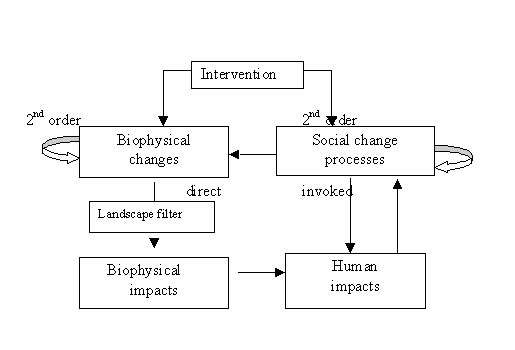
3. Theoretical framework 3.1 Frame of study Slootweg et al. (2001) have developed the framework for integrating environmental and social impact assessments. As I aim to construct a comprehensive picture of the impact of RNP on local people combining the social issues with environment, the framework of Slootweg et al. (2001) forms a good base for the study. Although the present study not include the aspects for measuring the environmental effects of the park and the concentration is in social issues, the framework explains the connection between the environment and human impacts. The idea is to found out the interrelationships of social impacts of the RNP and living environment which together builds up a picture of living of people and impacts of the project. The conceptual framework that Slootweg et al. (2001) uses separate biophysical, social and institutional settings. These settings originates from "functional evaluation " of nature where society constitutes the demand side and the environment the supply side. Biophysical setting constitutes the natural system and its different functions such as production, processing and regulation, carrying and signification functions. Social setting assigns socio-cultural, economic and ecological values and institutional setting forms from institutional arrangements, management practices, policy instruments and suasion. Social values refer the quality of life in general; which in present study are studied through living condition and health issues. In this study the concentration is in social setting with understanding of other settings. When physical intervention causes changes in these settings the framework provides a model for explaining them. The human impacts can be developed from the physical intervention and changes in biophysical setting. For example, as a positive effect, national park conserves forests (change in biophysical setting) that have influence on availability of water (bio-physical impact) and due to that agriculture and availability of food will improve (change in social setting). On the other hand, influence of national park as a restricting factor to use natural resources leads to too frequent cultivation period in agricultural lands that causes the degradation of soil and changes in production activities. Human impact of the intervention are derived from the changes in biophysical setting but as well results of the changes is social setting. Those human impacts derived from changes in biophysical setting are called indirect human impacts as those directly caused by the intervention direct human impacts (e.g. new job opportunities or improved health services caused by the intervention) With these impacts are referred to quantifiable variables such as economic or demographic issues as well as the changes in people's norms, values, beliefs and perceptions of the society they live, the generated differentation of impact and all other factors of life. The Figure 1. presents the whole framework for impact evaluation.
Figure 1 . The frame for deriving biophysical and human impacts adopted from Slootweg et al. 2001. Second order changes refer the changes caused by the first order changes for example increased population can lead to changes in food production. In addition, human impacts can have influence on social change processes as the social change processes can provoke biophysical changes e.g. new job opportunities can increase the number of the people in the area and this can lead to environmental problems. In this study the concentration is in human impacts but the framework is presented to understand its environmental connections.The difference between change and impact is one of most important aspects of this research. As Slootweg et al. (2001) distinct : changes happen, for example in population size (e.g. population growth) but the impact of this change is the changed perception about the nature of the community due its increased size. In other words, impacts are perceptions, feelings and experiences of the change or as well some impacts are corporeal (felt by the body as physical reality) in individual or communal level. As I assume that RNP has had some influence which has cause changes in research themes and this change has its impacts. However, it has to be taken into account that not all the change in the area is caused by RNP. Other factors as well could have had almost equal consequences.
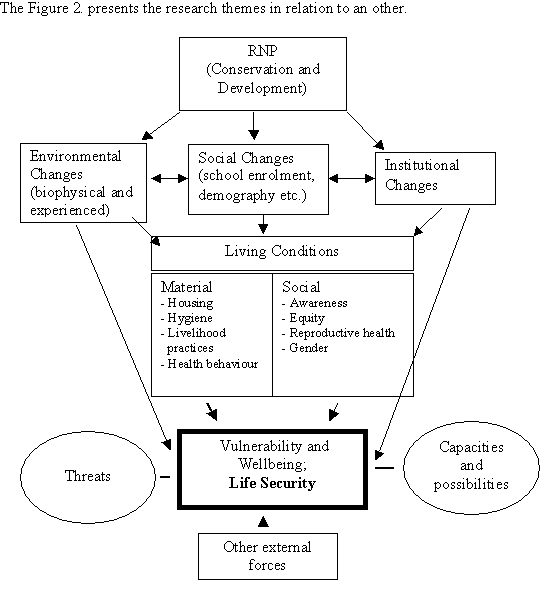
I combine concepts and aspects of social policy, as well as development and environmental studies. I want to present a life security perspective on international conservation project in developing country. As a basic assumption behind the research is the consideration that nature conservation should be as ecological but as well socially sound and sustainable. This has been pointed out already in UNCED Conference in Rio 1992. Often in conservation issues and also in this study, social sustainability is considered as the maintenance or improvement of local people's well-being (Wollenberg and Colfer 1997). Well-being, on its half, can be defined consisting of all the aspects of life that provide people a secure life such as security of access to resources, economic opportunity, decision- making opportunity, justice, heritage and identity as well as safety and health (Wollenberg and Colfer 1997). By development is often referred to spread of Western and modern culture and habits to the developing world as well as increase of well-being measured by some commonly agreed indicators. In this study development also local definition for development are looked for. However, the increase of education, better health, increased possibilities of the people to affect on their lives as well as improved knowledge of the surrounding world are considered signs of "Western " development. Local communities have been on focus in prevailing "community-based conservation". Local people are seen to form communities which have been e.g. the units of intervention. By community in conservation context is usually referred to "a spatial unit", "social structure" or "a set of shared norms" (Agrawal and Gibson 2001, 8). However, as recent studies have shown communities are not homogenous; multiple actors with multiple interests make up communities. In this study, I have used a term local people by which is meant people who originate and live near to national park, predominantly in the peripheral zone. The study of Harper (1999) showed how "local communities" in Ranomafana consist of people whose living is shaped by lineage, social caste, gender and age. This is why in this study communities are not seen homogenous rather aggregates consisting of different kind of individuals and groups. Environment is considered as physical surroundings consisting of living and non-living environmental factors. However, environment is seen to be socially constructed and perceptions of locals of those factors are looked for. Previous studies have found out that local people perceive the land through concept of tanindrazana (land of the ancestors) (Ferraro and Rakotondranjaona 1991, Peters, J. 1999), however, Harper (1999) and Marcus (2000) suggest that this concept originates from Merina administration not exactly from local residents. Tanindrazana authorise people to the land they clear. Nevertheless, local people see the land more valuable than just trees in it (Harper 1999). As in the presented framework (Slootweg et. al 2001) is expressed the natural environment provides several functions to people. By 1) production function it is meant the ability the environment to generate the products for people. 2) Processing and regulation functions relate the ability the ecosystem to maintenance and support the life. 3) Carrying function explains the availability to provide space for human activities and 4) signification function the value of nature itself. Local definitions, functions and meanings for environment and its quality as well as environmental changes are looked for. Living Conditions can be divided into "material" and "social" living conditions. This distribution can be considered to have similarities with Allardt's (1993) "Having, Loving and Being"- categories which points out the subjective and objective aspects of wellbeing as well the importance of social life and living as a human being, together with material indicators. Allardt's considerations can not be applied directly in this study as they tightly relate to Scandinavian well-fare society but the main idea is the same in the category used in this study. Material living conditions include housing conditions and materials, hygiene and part of the health behaviour (drinking water, washing, waste disposal, toilet use, diet etc.) as well as livelihood practices. Social living conditions include unity and traditions of community life, reproductive health, position of the gender, equity, awareness of the world and part of the health behaviour (such as increased alcohol and tobacco use). These components consisting the living conditions of this study can also be considered similar to assets of sustainable livelihood- thinking (Pretty 1998). Some aspects under the living conditions need to be defined more preciously: Reproductive issues are considered as important aspects of living conditions. Reproductive health has been identified broadly since Cairo conference on population (1994) meaning not merely absence of diseases concerning reproduction but total physical, mental and social wellbeing in reproduction as well as right to make decisions about one's own sexual life. Reproductive health includes both male and female perspectives. Female reproductive health concentrates usually on maternal health (Bergstrom 1994, 307) and women's rights to control and affect her life on reproductive issues. As well, women's role and position in the society, their knowledge and abilities to control their lives, specially in reproductive matters, are considered to be important issues in studying the change in the community. By equity is meant that development due an intervention should be equally distributed to all. RNP has worked through people's groups and formed new institutions in the area partly due the lack of already existing ones (Peters 1998). Appropriate methods to work with local people that are compatible with their society are crucial. I will study how the new institutions created by the park have influenced on the communities and how the benefit of the park has distributed equally between all the stakeholders. By awareness of the world is referred the connections to the "outer" world such as availability and use of newspapers, radio, TV and knowledge and understanding of the phenomena happening outside of the community. In addition, locality of the village obviously has influence on people's knowledge and experiences of outer world as the villages near to roads are more likely to receive visitors and influence from outside (Peters, D. 1992). Also the tourist aspect need to be considered. The increased number of tourists have changed the general atmosphere at least in Ranomafana centre. Effects of tourism are also noticed in raise of prices of staples in Ranomafana centre (Harper 1999). By vulnerability it is meant characteristics and abilities of people to anticipate, cope with, resist and recover from the crisis (modified from Blaikie et al. 1994, 9). Crisis can be caused e.g. by acute natural hazards (like storms, droughts etc.) or as " minor crisis" can be considered the hard times between the rice harvests when the food is in shortage. Hardenbergh (1993) found out the importance of forest plants in diet especially between the rice harvests. What makes vulnerability as an interesting research theme in this impact study is the fact that in the same time when the slow degradation of living environment (e.g. degradation of soil fertility) and population growth will make people more vulnerable for resisting crisis as the natural resources will no more be sufficient, the restriction of the use of remaining natural resources is done by RNP. However, on the other hand development components of RNP and water conserving characteristic of the national park might have substituted the restricting impact. Vulnerability and safety nets have crucial roles in "sustainable livelihood"- approach where ability to cope and recover from shocks are considered as important characteristics of sustainable survival (Pretty 1998)."Sustainable livelihoods" (SL)- thinking refers to " the capability of people to make living and improve their quality of life without jeopardising the livelihood options of others, either now or in the future" (UNDP). This framework has been mainly developed to connect and take into account all the factors that affect and form the livelihood activities of " the rural poor" . However, as I emphasis the holistic approach, SL- thinking provides good insights for studying the overall living of the people although defining the total livelihood composition, least in economic sense, is not under the scope of this study. In sustainable livelihood-thinking people have different kind of assets to gain their livelihoods. These include natural, social, human, physical and financial assets (Pretty 1998). Combining partly the components of these different assets it is possible to examine the living of the people and find out the role of RNP in it. The concept of life security is closely related to SL-thinking. As well life security consists of the aspects of life similar to well-being. However, life security can be considered as an opposite to insecure life where e.g. decline of resources, health and environmental hazards make life difficult. It is more concentrated on people's own perceptions of their lives and survival than defining quantitatively the whole system of livelihoods. Referring to change – impact differences presented above, perceived changes are in focus. It could be called as well "good life" but with security I want to refer the changeable and unstable side of life and living. Life security can also be considered to be close to human security. Human security has been defined in terms of threats, capacities and participation (Lonergan et al. 2000) and I consider this framework useful also in this study. However, the concept of human security is developed for larger scale applications and to create alternatives for GDP (ibid.). Life security is a socially constructed concept gathering together all the aspects affecting to people's lives and surviving in a dynamic process. The concept refers more to life on communal or group level than on individual. However, it does not consider the community as a homogeneous unit rather an aggregate consisting of individuals and groups. What makes life security as a relevant research theme in this study, is the interest to know how people survive when changes in their traditional living and survival strategies happen as well as how the changes in living environment affect the security. Social disintegration is an important concept related to social part of the life security, it refers the falling apart of existing social and cultural networks. This is studied through community structure and its change. Life security consists of characteristic of maintain the life socially and materially , in other words, abilities to survive in changing circumstances.
Figure 2. Scheme of research themes. Arrows express the influence of the factor to the other that cause the possible change. Life security, vulnerability and well-being are affected by both conservation as the development components of the RNP. By other external forces are meant national and international policies as well as effects of global market forces such as prices of cash crops essential for local people. Threats, capacities and possibilities define the life security.
4. Research methods This study consists of both quantitative and qualitative research methods and as well it combines different kinds of material and data. In developing studies triangulation is highly useful because the research is likely to confront many obstacles that are easy to eliminate in research which is happening in researcher's own country and culture (Burdge 1998, 237; Yach 1992, 604). Setting I will use the comparative strategy as I will compare the impact of the park in time and in place. I will study the villages which are under influence of the RNP as the villages more far away. The importance of use of the control "group" in this kind of studies is pointed out e.g. by Langholtz (1999) who has studied the success of developing activities in the buffer zone of the park in Guatemala. RNP overlaps tree fivondronanas (sub-provincial jurisdiction). Each fivondronana is divided into several communes (firaisana) which consist of fokotanys (groups of 2-6 villages). RNP with its peripheral zone overlaps seven communes. I selected 4 communes in the park area and 4 from more far away. From these communes I selected 12 villages, half of them from the peripheral zone and the other half outside of the zone. The criteria for selection were the situation of the village (accessible vs. remote), ethnicity (half of the villages and communes from Tanala and the other half from Betsileo) and the former studies conducted in the area. In addition, to get more deep understanding about what the people experience I will select two to four villages from those already visited villages for more closer study. Data collection The data is collected by following techniques:
I collected already existent statistic material which the local authorities had gathered. This material consisted of time series (between 1990-2000) of the demographic change (births and deaths, including infant deaths) and enrolment of school children. Health related information such as appearance of common diseases and familial planning was only available from last three years. Statistics were gathered in commune- level. In addition, some documents about the distribution of entrance fees, developing projects, health activities etc. from those organisations working in Ranomafana were collected. This material with results of previous studies and part of the observation material, as explained later on, will consist of the quantitative part of the research material. I visited each study village and interviewed the key persons (e.g. the teacher of the village, doctor, mid-wife, agricultural and health animators working in the villages, village elders etc.) about the research questions with semi-structured interviews. The validity of key person information is proved to be good and fruitful compared to surveys (Johnson 1988). The research method and the questions were tested in pilot village. The interviewed persons spoke Malagasy as did my interpreter who was a local student. The interviews were recorded and the essential point of the answers was translated to me directly that I was able to ask further questions. During the interview I had time to make notes of a situation as well observe the respondent. This kind of approach was realised to be useful when not knowing a respondents' language (Devereux 1993, 46). The sample of the informants increased by snow-ball technique (Patton 1990, 176). The recorded tapes were translated and transcribed to English by the translator who was an other person than my assistant in the interviews. I also will conduct group interviews in those villages selected for closer study using the focus group technique. I believe that group interviews are more suitable situations for the local people to express themselves. I conducted a group interview to test the method and I found the group situation to be more suitable for the local context. In addition, the focus groups are suitable research method to follow quantitative data collection, to understand quantitative data and to found out the perceptions and answers of the people for the questions that rise from quantitative data (Pötsönen and Välimaa 1998, 5). I will conduct focus groups among women and men (in different groups) from different ages. I will intend to have representatives from all social castes and wealth classes in the village. Some wealth ranking exercise will be organised before the groups discussions. The adorable group size is about 6-10 depending on situation. (Khan and Manderson 1992; Pötsönen and Välimaa 1998). The focus groups are controlled by a moderator who in my case will be my interpreter. He or she will act as person who will lead the discussion. I myself will act as a facilitator who records the conversation, observes the situation and makes notes. The whole discussion is translated into English favourably very soon after the discussion as the correction is still easy the made. Possibly I will combine some methods of PAR (Participatory Action Research) with focus group interview (e.g. problem web). The focus groups have resulted very suitable in health research both in the developing as in the developed world (Mgalla and Boerma 2001, Pötsönen and Välimaa 1998, Yach 1992, Khan and Manderson 1992) and also Ite (1996) has used them to explore the perceptions of National Park in Nigeria. Some more personal interviews can also be conducted as the persons will be clarified in focus groups. In addition, I observed and will observe the normal life and every possible phenomenon in every village I studied and wrote the diary about the observations. Little maps of each village indicating the source of water, situation of houses etc. were drawn by the assistant and villager (s). I used systematic observation of some relevant matters (such as clothes of people, source of household objects) but as well a free diary. However, participatory observation was not a primary method in this study as it is found difficult to conduct in proper way without not to be able to speak the local language. In addition to this, I proposed for the teachers in two high schools in the area to ask their students to write about their considerations about the environment, healthy environment and the future. Students wrote in Malagasy and the writings were translated to English. In total, 42 writings were collected. However, this material (interviews, focus groups, observation and school children's writings) will consist of the more qualitative and descriptive part of the whole research material. Data analysis As the material of the study is diverse, the methods of analysis will differ as well. However, the main approach in analysis will be comparison. I will compare the results between the villages near to park and far away from the park and in statistical part also the situation in past and in present. The quantitative material will be analysed by some basic statistical parameters and frequencies as well connections and common indicators between, remote situation vs. accessibility, belonging to the park peripheral zone etc. are explored. The transcribed and translated texts will be analysed. No sophisticated discourse analysis is made as the text is already translation from the other language. In translation part of the information will be lost as people express themselves richer way in their own language. The checking of mistakes in translation could be made by back- translation but as the quantity of data will be great that is considered very time-consuming and awkward. However, if there is any doubt that there could be some errors in translation, the back-translation is made preferably by other person. The loss of some information due the translation is the known fact that is not possible to eliminate as learning Malagasy properly will take too long time for me. However, I am studying Malagasy in order to know some basic words related to the theme to be able to control somehow the work of the interpreter and capture some ideas of the people by myself. This is pointed out by the other researcher who had conducted research in developing world without knowing properly the local language (Devereux and Hoddinott 1993, 16). The observation diaries with key person interviews are used to construct a " picture" of every village, especially those which are selected to closer examination, to characterise the general living conditions , community life and livelihoods in each village. These "village profiles" with the background information (documents and previous studies) are used in comparison between villages in and out of the buffer zone. The analysis of focus group discussions will consist of mostly the "ethnographic" analysis of translated texts (Morgan 1988). "The rough data" from the group interviews (texts and notes) will be put together to composed as a descriptive conclusion of the discussion. These "conclusions" will be analysed in order to recognise the main ideas and experiences of the each research theme. The perceptions between different groups (youngsters/older people, women/men villagers in peripheral zone and out of it) will be analysed. School children's writings are analysed by exploring the common ideas and considerations of the living environment and used to complement the group interviews as well giving the possible additional views as the student were more educated high school students. The main idea is to have a holistic conclusion of the impacts of RNP as derived from human and environmental living factors. Under the concept "life security" are gathered the essential aspects that consist of variety of matters that form people's living and its resistance to cope with changes. This conclusion will distinguish the essential aspects that have to be taken into account when planning conservation (or other projects) in the areas where people are directly dependent on and affected by the natural resources. 5. Research team The research is a part of the project " Ecological, Health- related and Socio- economical Changes in Threatened Rain Forests of Madagascar" funded by Academy of Finland. The project is divided into two parts: ecological and socio- economical. Prof. Jari Niemelä from department of Ecology and Systematics is a leader of the ecological part as well as the whole project. The ecological part will consist of mostly the research of M. Sc. Johanna Heinonen who is an other Ph.D student in the project. Dr. Ossi Rahkonen from the Department of the Social Policy is a head of the socio-economical part and will act as my supervisor as will do Dr. Juhani Koponen from Institute of Development Studies. In addition, Dr. Elina Hemminki from National Research and Development Centre for Social Well-fare and Health (STAKES) will act as a consultant in health matters. Other persons who will be closely part of my research will be my interpreter, the Malagasy student and my guide in the park. 6. Timetable
The socio-economical part of the project started on 2.5 2001. The summer 2001 was used for writing the research plan and preparing the whole research. This preparation work took place in Helsinki, in department of Social Policy. The first field trip to Madagascar took place from September to December in 2001. In this first trip I familiarised myself with the Malagasy culture and the area in general. I gathered the statistical information collected by local authorities. This information was placed in the provincial capital Fianarantsoa and the regional centres Ambohimahasoa and Ifanadiana as well the commune centres. However, my main staying place was Ranomafana National Park Research Centre from where I visited the study villages. From December 2001 to September 2002 I will spend in Helsinki writing backgrounds for the articles and analysing the data gathered in first field period. From September to December 2002 will be my other trip to Madagascar. The possible focus group interviews as well the other interviews will take place. After that second trip the actual writing period will start and if necessary I will still go to Madagascar for third time to complement my data. The funding of the Academy of Finland will finish in end of 2003 when I hope to have most of my articles done. 7. Publication plan The research will be published in a form of five to six scientific articles. The themes of the articles are as follows (very preliminary !): Concluding article: Life security – conservation, environmental problems and social changes in the rainforest community (threats and possibilities) local benefits, how the communities were considered etc. ) 3. Children's awareness on environment and environmental problems 4. Perceptions of changes in living environment, perceived impacts of the park – a gender perspective 5. Social living conditions and equity of impacts 8. T he significance and possible use of resultsThis study, beside of its scientific contributions, has a practical order. The social consequences of the Ranomafana National Park are wanted to be clarified by park founders. In the light of the results of the study the present situation can be improved. In addition, the situation of this park can be used as an example about the consequences of the conservation effort. The results as they will evaluate the situation of this park and bring the ideas of the locals into daylight, will be brought to wider global context especially in discussion of development and north- south relations and hopefully help other international conservation projects to adopt the proper ways to communicate with local people.
Abbot, J., Thomas, D., Gardner, A., Sama, N., Mbony, K. 2001. Understanding the Links Between Conservation and Development in the Bamenda Highlands, Cameroon. World Development 29 (7): 1115-1136. Allardt, E. 1998. Hyvinvointitutkimus ja elämänpolitiikka. In: Roos, J.P. and Hoikkala, T. (eds.) Elämänpolitiikka. 2000-luvun kirjasto. Gaudeamus. (In Finnish) Arens, W. 1985. Change and development in a Tanzanian Community. In: Skar, H. 1985 (ed.). Anthropological contributions to planned change and development. Gothenburg Studies in Social Anthropology 8.Acta Univerisitatis Gothogurgensis Agrawal, A. and Gibson, C. (eds.) 2001. Communities and the Environment. Ethnicity, Gender and the State in Community- Based Conservation. Rutgers University Press, New Jersey. Agrawal, A. and Gibson, C.2001. The role of Community in Natural Resources Conservation. In: Agrawal, A. and Gibson, C. (eds.) Communities and the Environment. Ethnicity, Gender and the State in Community- Based Conservation. Rutgers University Press, New Jersey. pp.1-31. ANGAP. 1998. Rapport semestriel 1998. ANGAP Blaikie, P., Cannon, T., Davis, I. and Wisner, B.1994. At Risk, Natural Hazards, People's Vulnerability and Disasters. Routledge, London. Boerma, T. and Mgalla, Z. (eds.) 2001. Women and infertility in sub-Saharan Africa: A multi- dicilpinary perspective. Royal Tropical Institute. KIT Publishers. Amsterdam, Netherlands. Boerma, T. and Mgalla, Z. (eds.) 2001. The discourse of Infertility in Tanzania. In : Boerma, T. and Mgalla, Z. (eds.) 2001. Women and infertility in sub-Saharan Africa: A multi- disciplinary perspective. Royal Tropical Institute. KIT Publishers. Amsterdam, Netherlands. pp.190-200. Brandon, K. and Wells, M. 1992. Planning for People and Parks : Design Dilemmas. World Development 20 (4): 557 –570. Brandon, K., Redford, K. and Sanderson, S. (eds.) 1998. Parks in Peril. People, Politics and Protected Areas. The Nature Conservancy. Island Press. Washington D.C. Brandon, K. 1998. Comparing Cases: A Review of Findings. In : Brandon, K., Redford, K. and Sanderson, S. (eds.) Parks in Peril. People, Politics and Protected Areas. The Nature Conservancy. Island Press. Washington D.C. Brechin, S., West, P., Harmon, D. and Kutay, K. 1991. Resident People and Protected Areas: A Framework for Inquiry. In: West, P. and Brechin, S. (eds.) 1991. Resident People and National Parks. Social Dilemmas and Strategies in International Conservation. The University of Arizona Press, Tuscon. Brechin, S., Wilhusen, P., Fortwangler, C. and West, P. 2002. Beyond the Square Wheel: Towards a More Comprehensive Understanding of Biodiversity Conservation as Social and Political Process. Society and Natural Resources 15: 41-64. Devereux, S. and Hoddinott, J. (eds.) 1993. Fieldwork in Developing Countries. Lynne Rienner Publishers, Boulder, Colorado. Devereux, S. 1993. "Observers are worried": Learning the language and counting the people in Northeast Ghana. In: Devereux, S. and Hoddinott, J. (eds.) 1993. Fieldwork in Developing Countries. Lynne Rienner Publishers, Boulder, Colorado. Devereux, S. and Hoddinott, J.1993. The context of fieldwork. In: Devereux, S. and Hoddinott, J. (eds.) 1993. Fieldwork in Developing Countries. Lynne Rienner Publishers, Boulder, Colorado. Ferraro, P. and, Rakotondranjaona B. 1991. Preliminary assessment of local population forest use, forest initiatives, agricultural operations, cultural diversity and the potential for rural development in the region of the Ranomafana National Park, 1990-1991. In: Socio- Economic Surveys in the Ranomafana National Park Periphery.1992. Ranomafana National Park Project Goodman, S. and Patterson, B. (eds.) 1997. Natural Change and Human Impact in Madagascar. Smithsonian Institution Press, Washington and London. Grenfell and Robinson. 1995. Ranomafana National Park Management Plan. Ranomafana National Park Project. Grove, R. 1995. Green Imperialism. Colonial Expansion, Tropical Island Edens and the Origins of Environmentalism, 1600-1860. Cambridge University Press.
Hanson, P. 1997. The politics of Need interpretation in Madagascar's Ranomafana National Park. Ph.D. dissertation in Folklore and Folklife, University of Pennsylvania. Hardenbergh, S.1993. Undernutrition, Illness and Children's work in an Agricultural Rain Forest Community of Madagascar. Ph.D. dissertation in Anthropology, University of Massachusetts. Harper, J. 1999. The Political Ecology of health and diseases among forest farmers of Southeastern Madagascar. Ph.D. dissertation in Anthropology, Michigan State University. Hough, J. 1988. Obstacles to Effective Management of Conflicts Between National Parks and Surrounding Human Communities in Developing Countries. Environmental Conservation 15 (2): 129-136. Ite, U. 1996. Community perceptions of the Cross River National Park, Nigeria. Environmental Conservation 23 (4): 351-357. Johnson, J. 1988. Selecting Ethnographic Informants. Qualitative Research Methods Series 22. Sage University Paper. Sage Publications. USA. Khan, ME and Manderson, L. 1992. Focus Groups in Tropical Diseases Research. Health Policy and Planning 7 (1): 56-66. Kightlinger,L., Kightlinger, M., Martial, R., Joelson, R., Solofo, R. and Voahirana, R. 1992. Socio- economic and health aspects of eighteen communities surrounding Ranomafana National Park, Madagascar, 1990-91. In: Socio- Economic Surveys in the Ranomafana National Park Periphery.1992. Ranomafana National Park Project. Kightlinger, L., Paine, S. and Kightlinger, M. 1990. Human health Survey of Seven Communities on the Periphery of Ranomafana National Park, Madagascar. Man and the Malagasy Rain Forest: An Integrated Conservation Project. Fianarantsoa, Madagascar. Unpublished report Kitzinger, J. 1994. The Methodology of Focus Groups: the Importance of interaction between research participants. Sociology of Health and Illness 16 (1) : 102-121. Kottak, C. 1971. Cultural Adaptation, Kinship and Descent in Madagascar. Southewestern Journal of Anthropology 27 (2): 129-147. Langholz, J. 1999. Exploring the Effects of Alternative Income Opportunities on Rainforest Use: Insights from Guatemala's Maya Biosphere Reserve. Society and Natural Resources 12 : 139- 149. Lonergan, S., Gustavson, K. and Carter, B. 2000. The Index of Human Insecurity. AVISO 6. The Global Environmental Change and Human Security (GECHS). Lappalainen, A. 2002. Combining Conservation and Development: Views and opinions of the resident population of villages nearby to Ranomafana National Park, Madagascar. Master's thesis. Department of Geography. University of Helsinki Marcus, R.R. 2000. Cultivating Democracy on Fragile Grounds: Environmental Institutions and Non-elite Perceptions of Democracy in Madagascar and Uganda. Doctoral dissertation. University of Florida. Morgan, D. 1988. Focus groups as qualitative research. Sage University Paper Series on Qualitative Research Methods 16. Newbury Park, CA. Oxby, C.1985. Forest Farmers the transformation of land use and society in Eastern Madagascar. Unasylva 37 (148): 42-51. Olsen, M., Canan, P. and Hennessy, M. 1985. A Value-Based Community Assessment Process. Integrating Quality of Life and Social Impact Studies. Sociological Methods and Research 13 (3): 325-361) Patton, M. 1990. Qualitative Evaluation and Research Methods. SAGE Publications USA. 532 p. Peters, D. 1992. A Sociological/ Anthropological Study of Two Tanala and Two Betsileo Villages. In: Socio- Economic Surveys in the Ranomafana National Park Periphery.1992. Ranomafana National Park Project. Peters, D. 1994- 95. Social Impact Assessment of the Ranomafana National Park Project of Madagascar. Impact Assessment 12 : 385-408. Peters, J. 1998. Sharing National Park Entrance Fees: Forging New Partnership in Madagascar. Society and Natural Resources 11: 517-530. Peters, J. 1999. Understanding conflicts between people and parks at Ranomafana, Madagascar. Agriculture and Human Values 16: 65-74. Pretty, J. 1998. Capital Assets and Natural Resources Improvements: Linkages and New Challenges. Centre for Environment and Society, University of Essex, Colchester, UK. Pötsönen, R. and Välimaa, R. 1998. Ryhmähaastattelu laadullisen terveystutkimuksen menetelmänä. Terveystieteen laitoksen julkaisusarja 9/1998. University of Jyväskylä (In Finnish) Skar, H. 1985 (ed.). Anthropological contributions to planned change and development. Gothenburg Studies in Social Anthropology 8.Acta Univerisitatis Gothogurgensis. Samisoa, M. 1992. Socio-economic Diagnostic Survey in the Periphery Zone of the Ranomafana National Park. In: Socio- Economic Surveys in the Ranomafana National Park Periphery.1992. Ranomafana National Park Project Seale, C. (ed.) 1999. Researching Society and Culture. SAGE Publications London. 349 p. Slootweg, R., Vanclay, F. and Schooten van M. 2001. Function evaluation as a framework for the integration of social and environmental impact assessment. Impact Assessment and Project Appraisal 19 (1): 19-28. Socio- Economic Surveys in the Ranomafana National Park Perihhery.1992. Ranomafana National Park Project. Uphoff, N. and Langholz, J. 1998. Incentives for avoiding the Tragedy of the Commons. Environmental Conservation 25 (3): 251-261. West, P. 1991. Introduction, In: West, P. and Brechin, S. (eds.) 1991. Resident People and National Parks. Social Dilemmas and Strategies in International Conservation. The University of Arizona Press, Tuscon. West, P. and Brechin, S. (eds.) 1991. Resident People and National Parks. Social Dilemmas and Strategies in International Conservation. The University of Arizona Press, Tuscon. Willhusen, P., Brechin, S., Fortwangler, C. and West, P. 2002. Reinventing a Square Wheel: Critique of a Resurgent "Protection Paradigm" in International Biodiversity Conservation. Society and Natural Resources 15 : 17-40. Wollenberg, E. and Colfer, C. 1997. Social Sustainability. In : Borrini-Feyerabend,(ed.). 1997. Beyond Fences: Seeking Social Sustainability in Conservation, IUCN, Gland (Switzerland). Published in world wide web: http://iucn.org/themes/psg/beyond_fencesWright, P. 1997. The Future of Biodiversity in Madagascar. In: Goodman, S. and Patterson, B. (eds.) 1997. Natural Change and Human Impact in Madagascar. Smithsonian Institution Press, Washington and London. Yach, D. 1992. The Use and value of qualitative methods in health research in developing countries. Social Science Medicine 35 (4): 603-612.
|